Answer 48 questions, check each correct answer and work through the explanations at your own pace.
Question 1 of 480 correct answers
Question 1 of 48
What could you do to reduce the volume of traffic on the roads?
Explanation
Try not to use your car as a matter of routine. For shorter journeys, consider walking or cycling instead - this is much better for both you and the environment.
Question 2 of 48
Why should you never wave people across at pedestrian crossings?
Explanation
If people are waiting to use a pedestrian crossing, slow down and be prepared to stop. Don't wave them across the road, because another driver may not have seen them, may not have seen your signal, and may not be able to stop safely.
Question 3 of 48
What's the purpose of road humps, chicanes and narrowings?
Explanation
Traffic-calming measures help to keep vehicle speeds low in congested areas where there are pedestrians and children. A pedestrian is much more likely to survive a collision with a vehicle travelling at 20 mph than they are with a vehicle travelling at 40 mph.
Question 4 of 48
What requires extra care when you're driving or riding in windy conditions?
Explanation
Always give cyclists plenty of room when overtaking them. You need to give them even more room when it's windy. A sudden gust could easily blow them off course and into your path.
Question 5 of 48
How would age affect an older person's driving ability?
Explanation
As people age, their reaction time gets slower. The rate of decline varies from person to person but you can expect them to take longer to react to a hazard and they may be hesitant in some situations - for example, at a junction.
Question 6 of 48
You're waiting to come out of a side road. Why should you look carefully for motorcycles?
Explanation
If you're waiting to emerge from a side road, look carefully for motorcycles: they can be difficult to see. Be especially careful if there are parked vehicles or other obstructions restricting your view.
Question 7 of 48
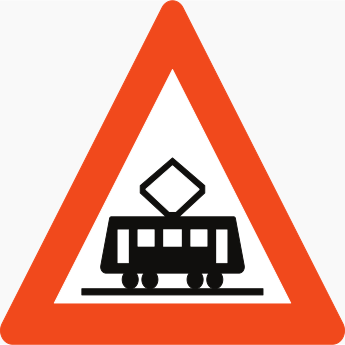
What does this sign mean?
Explanation
Take extra care when you encounter trams. Look out for road markings and signs that alert you to them. Modern trams are very quiet and you may not hear them approaching.
Question 8 of 48
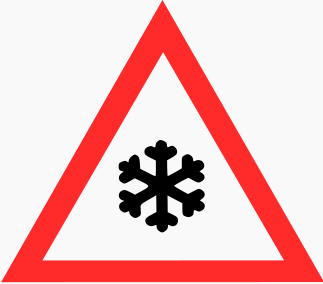
What does this sign mean?
Explanation
It will take up to 10 times longer to stop when it's icy. Where there's a risk of icy conditions, you need to be aware of this and take extra care. If you think the road may be icy, don't brake or steer harshly, as your tyres could lose their grip on the road.
Question 9 of 48
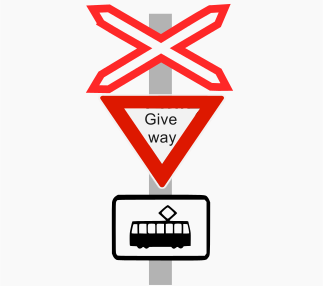
What does this sign mean?
Explanation
Obey the 'give way' signs. Trams are unable to steer around you if you misjudge when it's safe to enter the junction.
Question 10 of 48
What does a red traffic light mean?
Explanation
Whatever light is showing, you should know which light is going to appear next and be able to take appropriate action. For example, when amber is showing on its own, you'll know that red will appear next. This should give you ample time to anticipate and respond safely.
Question 11 of 48
What's the purpose of a catalytic converter?
Explanation
Catalytic converters reduce a large percentage of harmful exhaust emissions. They work more efficiently when the engine has reached its normal working temperature.
Question 12 of 48
What colour are the reflective studs along the left-hand edge of the motorway?
Explanation
Reflective studs are used to help you in poor visibility. Different colours are used so that you'll know which lane you're in. These are
Question 13 of 48
What must you do when you're overtaking a car at night?
Explanation
To prevent your headlights from dazzling the driver of the car in front, wait until you've passed them before switching to main beam.
Question 14 of 48
You've just gone through flood water. What should you do to make sure your brakes are working properly?
Explanation
Water on the brakes will act as a lubricant, causing them to work less efficiently. Using the brakes lightly as you go along will quickly dry them out.
Question 15 of 48
When should you flash your headlights at other road users?
Explanation
You should only flash your headlights to warn others of your presence. Don't use them to greet others, show impatience or give priority to other road users, because they could misunderstand your signal.
Question 16 of 48
You're following a slower-moving vehicle. What should you do if there's a junction just ahead on the right?
Explanation
You should never overtake as you approach a junction. If a vehicle emerged from the junction while you were overtaking, a dangerous situation could develop very quickly.
Question 17 of 48
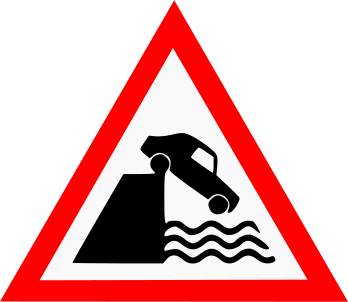
What does this sign mean?
Explanation
You should be careful in these locations, as the road surface is likely to be wet and slippery. There may be a steep drop to the water, and there may not be a barrier along the edge of the road.
Question 18 of 48
You're parked on the road at night. When must you use parking lights?
Explanation
When parking at night, park in the direction of the traffic. This will enable other road users to see the reflectors on the rear of your vehicle. Use your parking lights if the speed limit is over 30 mph.
Question 19 of 48
What should you do when you're approaching roadworks on a motorway?
Explanation
Be aware of reduced speed limits at roadworks. Speed limits shown inside a red circle are mandatory and cameras are often used to enforce the reduced limit. Slow down in good time and keep your distance from the vehicle in front.
Question 20 of 48
What should you do if the left-hand pavement is closed due to street repairs?
Explanation
Where street repairs have closed off pavements, proceed carefully and slowly, as pedestrians might have to walk in the road.
Question 21 of 48
What should you do immediately after joining a motorway?
Explanation
When you've just joined a motorway, stay in the left-hand lane long enough to get used to the higher speeds of motorway traffic before considering overtaking.
Question 22 of 48
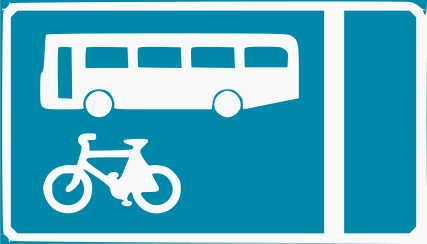
What does this sign mean?
Explanation
Buses and cycles can travel in this lane. In this example, they'll flow in the same direction as other traffic. If it's busy, they may be passing you on the left, so watch out for them. Times on the sign will show the lane's hours of operation; if no times are shown, or there's no sign at all, this means the lane is in operation 24 hours a day. In some areas, other vehicles, such as taxis and motorcycles, are allowed to use bus lanes. The sign will show if this is the case.
Question 23 of 48
What should you do if you see a large box fall from a lorry onto the motorway?
Explanation
Lorry drivers can be unaware of objects falling from their vehicles. If you see something fall onto a motorway, look to see if the driver pulls over. If they don't stop, don't attempt to retrieve the object yourself. Pull onto the hard shoulder near an emergency telephone and report the hazard.
Question 24 of 48
You're about to overtake a cyclist. Why should you leave them as much room as you would give to a car?
Explanation
Before overtaking, assess the situation. Look well ahead to see whether the cyclist will need to change direction. Be especially aware of a cyclist approaching parked vehicles, as they'll need to alter course. Don't pass too closely or cut in sharply as this could unsettle the rider.
Question 25 of 48
You're the first person to arrive at an incident where people are badly injured. You've switched on your hazard warning lights and checked all engines are stopped. What else should you do?
Explanation
If you're the first to arrive at a crash scene, the first concerns are the risk of further collision and fire. Ensuring that vehicle engines are switched off will reduce the risk of fire. Use hazard warning lights so that other traffic knows there's a need for caution. Make sure the emergency services are contacted; don't assume it's already been done.
Question 26 of 48
Which document may the police ask you to produce after you've been involved in a collision?
Explanation
You must stop if you've been involved in a collision that results in injury or damage. The police may ask to see your driving licence and insurance details at the time or later at a police station.
Question 27 of 48
You've just passed your driving test. How can you reduce your risk of being involved in a collision?
Explanation
New drivers and riders are often involved in a collision or incident early in their driving career. Due to a lack of experience, they may not react to hazards appropriately. Approved training courses are offered by driver and rider training schools for people who have passed their test but want extra training.
Question 28 of 48
Why should you switch your headlights on when it first starts to get dark?
Explanation
Your headlights and tail lights help others on the road to see you. It may be necessary to turn on your headlights during the day if visibility is reduced; for example, due to heavy rain. In these conditions, the light might fade before the street lights are timed to switch on. Be seen to be safe.
Question 29 of 48
You're waiting in a traffic queue at night. How can you avoid dazzling drivers behind you?
Explanation
In queuing traffic, your brake lights can dazzle drivers behind you. If you apply your parking brake, you can take your foot off the footbrake. This will turn off the brake lights so that they can't dazzle the driver behind you.
Question 30 of 48
You're driving in traffic at the speed limit for the road. What should you do if the driver behind is trying to overtake?
Explanation
Keep a steady course to give the driver behind an opportunity to overtake safely. If necessary, slow down. Reacting incorrectly to another driver's impatience can lead to danger.
Question 31 of 48
How will a roof rack affect your car?
Explanation
A roof rack increases your car's wind resistance. This will cause an increase in fuel consumption, so you should remove it when it isn't being used. An aerodynamically designed roof rack or box will help reduce wind resistance to a minimum, but the rack or box should still be removed when it isn't in use.
Question 32 of 48
You're about to go down a steep hill. What should you do to control the speed of your vehicle?
Explanation
When driving down a steep hill, gravity will cause your vehicle to speed up. This will make it more difficult for you to stop. To help keep your vehicle's speed under control, select a lower gear to give you more engine braking and make careful use of the brakes.
Question 33 of 48
What does the solid white line at the side of the road indicate?
Explanation
The continuous white line shows the edge of the carriageway. It can be especially useful when visibility is restricted, such as at night or in bad weather. It's discontinued in some places; for example, at junctions, lay-bys, entrances or other openings.
Question 34 of 48
What should you do if you're driving on a motorway and you miss the exit that you wanted to take?
Explanation
It's illegal to reverse, cross the central reservation or drive against the traffic flow on a motorway. If you miss your exit, carry on until you reach the next one. Ask yourself why you missed your exit - if you think that your concentration is fading, take a break before continuing your journey.
Question 35 of 48
When may you drive without wearing your seat belt?
Explanation
You may remove your seat belt while you're carrying out a manoeuvre that includes reversing. However, you must remember to put it back on again before you resume driving.
Question 36 of 48
You're carrying two 13-year-old children and their parents in your car. Who's responsible for seeing that the children wear seat belts?
Explanation
Seat belts save lives and reduce the risk of injury. If you're carrying passengers under 14 years old, it's your responsibility as the driver to ensure that their seat belts are fastened or they're seated in an approved child restraint.
Question 37 of 48
Why is it particularly important to check your vehicle before making a long motorway journey?
Explanation
Before you start your journey, make sure that your vehicle can cope with the demands of high-speed driving. You should check a number of things; the main ones being fuel, oil, water and tyres. You also need to plan rest stops if you're making a long journey.
Question 38 of 48
Who's responsible for making sure that a vehicle isn't overloaded?
Explanation
Carrying heavy loads will affect control and the vehicle's handling characteristics. If the vehicle you're driving is overloaded, you'll be held responsible.
Question 39 of 48
When could the cost of your insurance be reduced?
Explanation
The cost of insurance varies with your age and how long you've been driving. Usually, the younger you are, the more expensive it is, especially if you're under 25. Pass Plus provides additional training to newly qualified drivers. The scheme is recognised by many insurance companies, and taking this extra training could give you reduced insurance premiums, as well as improving your skills and experience.
Question 40 of 48
What does the term 'blind spot' mean?
Explanation
Modern vehicles provide the driver with a good view of both the road ahead and behind using well-positioned mirrors. However, the mirrors can't see every angle of the scene behind and to the sides of the vehicle. It's essential that you know when and how to check the vehicle's blind spots, so that you're aware of any hidden hazards.
Question 41 of 48
When should you leave a two-second gap between your vehicle and the one in front?
Explanation
In good, dry conditions, a driver needs to keep a distance of at least two seconds from the car in front. This should allow enough space for you to stop if the driver in front has to stop suddenly.
Question 42 of 48
How can you use your vehicle's engine as a brake?
Explanation
When driving on downhill stretches of road, selecting a lower gear gives increased engine braking. This will prevent excessive use of the brakes, which become less effective if they overheat.
Question 43 of 48
In order to supervise a learner driver you need to have held a full driving licence for the same category of vehicle, for at least three years. What other requirement must you meet?
Explanation
Learner drivers benefit by combining professional driving lessons with private practice. However, you need to be at least 21 years old and have held your driving licence for at least 3 years before you can supervise a learner driver.
Question 44 of 48
What's the legal minimum insurance cover you must have to drive on public roads?
Explanation
The minimum insurance required by law is third-party cover. This covers your liability to others involved in a collision but not damage to your vehicle. Basic third-party insurance also won't cover theft or fire damage. Ask your insurance company for advice on the best cover for you and make sure that you read the policy carefully.
Question 45 of 48
What should you do if your vehicle catches fire while you're driving through a tunnel?
Explanation
If it's possible, and you can do so without causing further danger, it may be safer to drive a vehicle that's on fire out of a tunnel. The greatest danger in a tunnel fire is smoke and suffocation.
Question 46 of 48
What style of driving causes increased risk to everyone?
Explanation
Competitive driving increases the risks to everyone and is the opposite of responsible, considerate and defensive driving. Defensive driving is about questioning the actions of other road users and being prepared for the unexpected. Don't be taken by surprise.
Question 47 of 48
You're waiting to emerge at a junction. Your view is restricted by parked vehicles. What can help you to see traffic on the road you're joining?
Explanation
You must be completely sure it's safe to emerge. Try to look for traffic through the windows of the parked cars or in the reflections in windows. Keep looking in all directions as you slowly edge forwards until you can see it's safe.
Question 48 of 48
You want to put a rear-facing baby seat on the front passenger seat. What must you do if the passenger seat is protected by a frontal airbag?
Explanation
It's illegal to fit a rear-facing baby seat into a passenger seat protected by an active frontal airbag. If the airbag activates, it could cause serious injury or even death to the child. You must secure it in a different seat or deactivate the relevant airbag. Follow the manufacturer's advice when fitting a baby seat.