Answer 47 questions, check each correct answer and work through the explanations at your own pace.
Question 1 of 470 correct answers
Question 1 of 47
You're overtaking a motorcycle in windy conditions. Why should you check your nearside mirror?
Explanation
You must check the nearside mirror during and after overtaking a motorcyclist. Make sure that the rider is still in control and that your vehicle's draught hasn't caused them to lose their balance.
Question 2 of 47
What danger should you be most aware of if you're driving close to the kerb in a busy shopping area?
Explanation
When you need to drive close to the kerb, be aware of the dangers.
Question 3 of 47
You've been taking medicine for a few days, and it has made you feel drowsy. Today you feel better, but you still need to take the medicine. When should you drive?
Explanation
Take care; it's not worth taking risks. Always check with your doctor to be absolutely sure. The medicine may have an effect on you later in the day and for longer than you think.
Question 4 of 47
What should you do if the vehicle ahead is being driven by a learner?
Explanation
Learners might take longer to react to traffic situations. Don't unnerve and intimidate them by driving up close behind.
Question 5 of 47
You're on a country road. What should you expect to see coming towards you on your side of the road?
Explanation
On a quiet country road, always be aware that there may be a hazard just around the next bend, such as a slow-moving vehicle or pedestrians. There might not be a pavement and people may be walking on your side of the road.
Question 6 of 47
What should you do before entering a tunnel?
Explanation
On the approach to many tunnels, a board will indicate a local channel or radio frequency that you should tune into. This should give a warning of any incident or congestion in the tunnel ahead. Severe loss of life has occurred in tunnel fires. Getting advance warning of any problems ahead will help you to take appropriate action in good time.
Question 7 of 47
What does it indicate if you see white lights on a vehicle at night?
Explanation
At night, you can tell whether a vehicle is facing towards or away from you by the colour of its lights. Additionally, its brake lights or indicators can give you information about its direction and intentions. This information helps you to make safe driving decisions.
Question 8 of 47
You're driving at night. Why should you ensure that all your lights are clean and working correctly?
Explanation
As well as headlights and tail lights, large vehicles have additional lighting to help other road users see the size of the vehicle. All lights should be clean and working properly. Driving at night when your vehicle is poorly lit is dangerous for you and other road users.
Question 9 of 47
You're driving on the motorway and want to use your mobile phone. What should you do before using it?
Explanation
Plan your journey and take breaks to keep in touch if necessary. When driving on motorways, you can't just stop to use your mobile phone. You'll need to turn off the motorway or wait until you reach the next service area. Avoid being distracted by switching your phone off while you're driving; use the message facility to listen to any calls when you've parked safely.
Question 10 of 47
At toucan crossings, pedestrians share the crossing with which other road users?
Explanation
A toucan crossing is signal-controlled, but unlike a pelican crossing it doesn't have a flashing amber light in the sequence. Cyclists and pedestrians cross together, and cyclists are allowed to ride their bicycles over the crossing.
Question 11 of 47
You're stationary. The brake air-pressure warning light comes on. Why should you keep the parking brake on?
Explanation
Even though a warning device indicates low air-brake pressure, you may still be able to release the parking brake. If you do this and start moving, the service brake may be ineffective and you may not be able to stop.
Question 12 of 47
You've been involved in an incident and damaged some property. What should you do if nobody else is present and your vehicle is still roadworthy?
Explanation
If you're involved in an incident that causes damage or injury to a person or property, you must stop. You must also give your details to anyone who has reasonable grounds to ask for them. If you don't do this, you must inform the police as soon as possible and in any case within 24 hours.
Question 13 of 47
You're found to be two-and-a-half times over the legal drink-drive limit and are disqualified from driving. Before regaining your licence, who will you have to satisfy that you don't have an alcohol problem?
Explanation
If you're disqualified from driving because you were two-and-a-half times over the legal limit, you'll be classified as a high-risk offender. Before you can regain your licence, you'll have to satisfy the Driver and Vehicle Licensing Agency (DVLA) that you don't have an alcohol problem.
Question 14 of 47
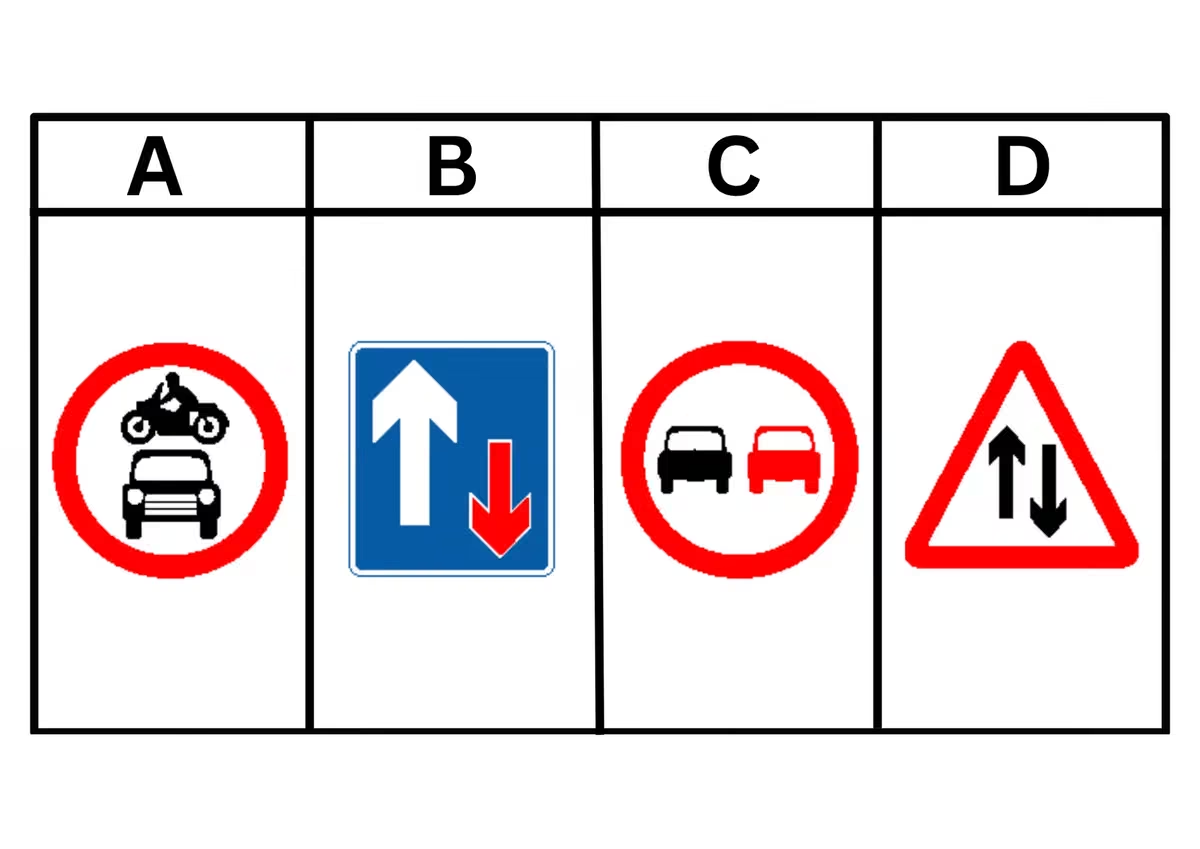
Which sign means 'no overtaking'?
Explanation
This sign is placed on sections of road where overtaking would be dangerous. There'll often be a plate underneath the sign, telling you how far the restriction extends. You mustn't overtake until you pass another sign cancelling the restriction.
Question 15 of 47
In which part of the United Kingdom do traffic officers operate?
Explanation
Traffic officers have powers to stop vehicles on safety grounds; for example, if you have an insecure load. They only operate in England and Wales. It's an offence not to comply with their directions.
Question 16 of 47
What's the purpose of an emergency refuge area on a smart motorway?
Explanation
Emergency refuge areas may be found next to the hard shoulder on a smart motorway. If possible, you should use one of these areas, rather than the hard shoulder, when you break down. If the hard shoulder is being used as a running lane, take care when you rejoin the motorway.
Question 17 of 47
You're driving under EU tachograph regulations and lose your smart card. When must you inform the relevant authority?
Explanation
As a professional driver, you have a responsibility to report any loss or theft of your digital smart card. You must inform the nearest relevant authority within seven days.
Question 18 of 47
A driver is convicted of obstructing an enforcement officer in the course of their duties. Under EU drivers' hours regulations, what's the maximum fine they can receive?
Explanation
EU drivers' hours regulations say that any driver who fails to comply with, or obstructs, an enforcement officer in the course of their duties can face an unlimited fine.
Question 19 of 47
Your vehicle is fitted with air-assisted hydraulic brakes. What fault would you suspect if the brake pedal becomes hard to press?
Explanation
A fault in the vacuum pump could be the cause of a stiff brake pedal. There could also be a leaking connection allowing air into the vacuum. Don't continue your journey until the fault has been fixed.
Question 20 of 47
What happens to diesel fuel when it gets hot?
Explanation
On a hot day, the fuel in your tank will expand. If this happens when the tank has been filled to the brim, fuel will spill onto the road. This can be very dangerous or even fatal for other road users - especially motorcyclists. Allow for this expansion when filling your tank.
Question 21 of 47
What must you do if your bus has hit a parked vehicle and the owner can't be found?
Explanation
If you damage a parked vehicle and the owner isn't around, you must report it to the police within 24 hours. This applies to any property you might have damaged. In Northern Ireland, all incidents must be reported to the police immediately.
Question 22 of 47
Before each journey, you should check all warning lights. What should you do if a warning light remains lit?
Explanation
Many buses and coaches have a large panel of warning lights on the dashboard. A system check built into the ignition system will allow you to check that all the warning-light bulbs are working before you start your journey. If a warning light stays on, there's a fault. Have it checked before continuing. Remember, your passengers' lives are in your hands.
Question 23 of 47
What effect will continuous use of the air-conditioning system have on fuel consumption?
Explanation
Avoid using air-conditioning systems for long periods, as they can increase fuel consumption by about 15%. Try to drive with fuel economy and the environment in mind.
Question 24 of 47
When do you need to take account of your vehicle having air suspension?
Explanation
Vehicles fitted with air suspension can sometimes move a considerable amount when the airbags are inflated. If you're parked too close to another vehicle or obstruction, this could result in collision damage.
Question 25 of 47
When should an anti-lock braking system (ABS) warning light turn off?
Explanation
Every vehicle fitted with anti-lock brakes must have a warning light in the cab of the vehicle. The warnings may differ between manufacturers, but on all types the warning light should come on when the ignition is switched on, and turn off when the vehicle reaches a speed of 6 mph (10 km/h). If the light stays on, there may be a fault; you should have the brakes checked before continuing your journey.
Question 26 of 47
What should your passengers do with their belongings when you arrive at your destination?
Explanation
Passengers shouldn't leave any personal property on the vehicle, unless it can be locked in secure luggage compartments.
Question 27 of 47
What does good passenger care include?
Explanation
Always show consideration to passengers, whether they have special needs or not. Try to imagine what assistance you would like if you were in their position.
Question 28 of 47
What should you do when you're driving through a bus station?
Explanation
Bus stations are busy places. If people are in a rush, they may not always look properly before getting off a bus. Keep your speed down and look for manoeuvring vehicles or pedestrians stepping into your path.
Question 29 of 47
You're making a journey that crosses international borders. Which document should you produce at immigration control?
Explanation
When passing through immigration control, you should have a list of all your passengers. They must all be accounted for.
Question 30 of 47
Your bus catches fire in a tunnel and can't be driven any further. What should you do when you've stopped safely at the side of the road?
Explanation
If your vehicle catches fire and you can drive it out of the tunnel, you should do so. If you can't do this, stop at the side of the road and switch off the engine. Move your passengers calmly but quickly to the nearest exit.
Question 31 of 47
Why do motorcyclists often look over their right shoulder just before turning right?
Explanation
Expect a motorcyclist who makes a quick glance over their shoulder to be changing direction. They should do this before turning. By observing this, you'll get an early clue of their intention.
Question 32 of 47
What action should you take if there are flashing amber lights under a school warning sign?
Explanation
The flashing amber lights are switched on to warn you that children may be crossing near a school. Drive slowly and be prepared for children running into the road.
Question 33 of 47
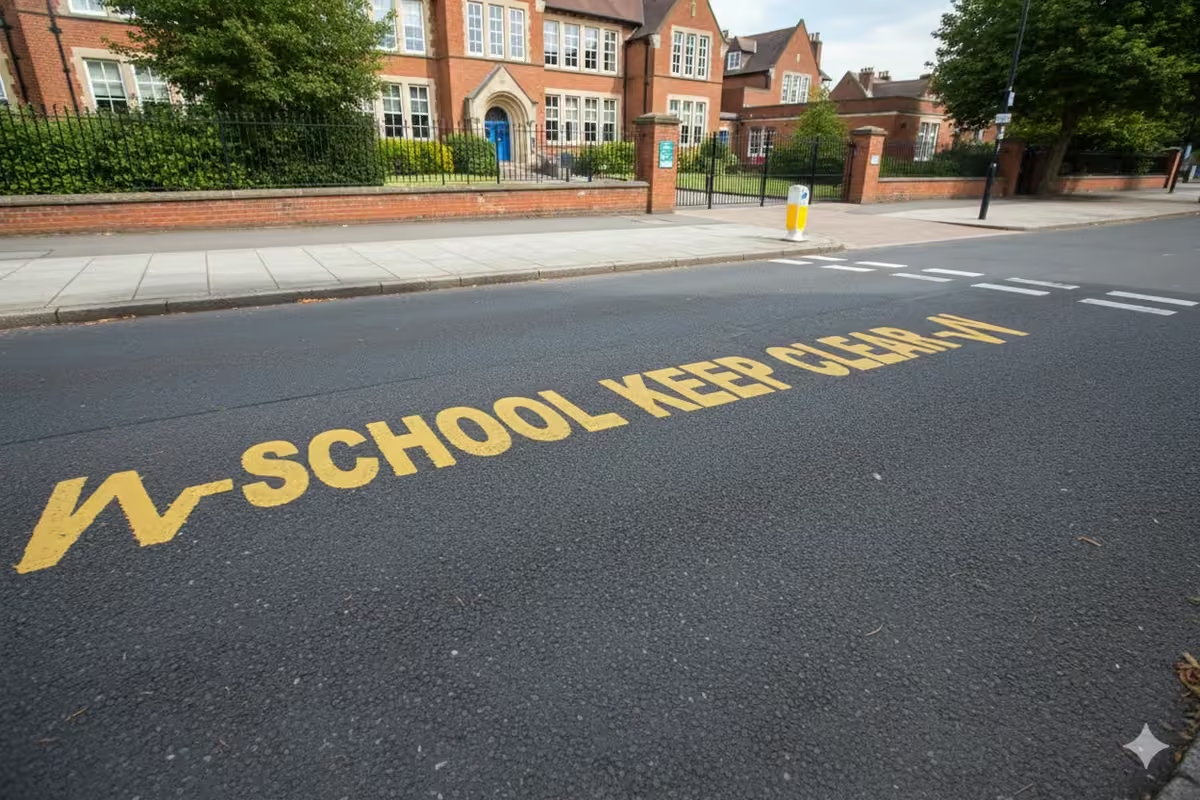
Why must these road markings be kept clear?
Explanation
Keeping the markings clear ensures that drivers and riders passing and children crossing have a clear, unrestricted view of each other.
Question 34 of 47
You're driving through a congested tunnel. What should you do if you have to stop?
Explanation
It's important to keep a safe distance from the vehicle in front at all times. This still applies in congested tunnels, even if you're moving very slowly or have stopped. If the vehicle in front breaks down, you may need room to manoeuvre past it.
Question 35 of 47
You're driving in a built-up area. Your vehicle is fitted with an audible warning device that sounds when it's reversing. When must you turn off this alarm?
Explanation
Some vehicles are fitted with an audible warning that sounds when the vehicle is reversing. This is an effective way to warn pedestrians and other road users of a reversing vehicle, but it doesn't take away the need to use effective observation all around your vehicle before and while you're reversing. Don't use the device in built-up areas between 11.30 pm and 7.00 am. Have consideration for the residents and don't disturb them with excessive noise.
Question 36 of 47
What can happen to drivers who break EU tachograph regulations?
Explanation
The driver must take responsibility and follow the drivers' hours and tachograph rules. Failure to do so can result in legal action and penalties - such as a fine.
Question 37 of 47
Under EU rules, what's the normal weekly rest period that must be taken?
Explanation
The working week is defined as from 00.00 hours on Monday to 24.00 hours on the following Sunday. When taking the weekly rest period, a daily rest period must normally be extended to at least 45 consecutive hours.
Question 38 of 47
You arrive at the scene of an incident. The emergency services have already been called. A pedestrian is bleeding heavily from a leg wound, but their leg isn't broken. What should you do to help them?
Explanation
Lift the pedestrian's leg so that the wound is higher than their heart. This should reduce the flow of blood. Check that the limb isn't broken and there's nothing in the wound before applying pressure over it.
Question 39 of 47
What should you do when you're driving through a tunnel in heavy traffic?
Explanation
In congested tunnels, you should always obey the instructions given by variable message signs and tunnel officials. Listen out for radio announcements and observe the road signs and signals. Keep your distance from the vehicle in front.
Question 40 of 47
At an incident, a casualty has stopped breathing. What should you do to help them?
Explanation
To help a casualty who isn't breathing, you should remove any obstructions from their mouth and tilt their head back slightly. These actions will help to keep their airway clear and maintain the correct position if mouth-to-mouth resuscitation is required.
Question 41 of 47
You've had an incident while driving through a tunnel. You aren't injured but your vehicle can't be driven. What's the first thing you should do in this situation?
Explanation
If you're involved in an incident in a tunnel, be aware of the danger this can cause to other traffic. You should immediately switch on your hazard warning lights and switch off your engine.
Question 42 of 47
While driving through a tunnel, your vehicle catches fire. What's the first thing you should do if the vehicle can't be driven out of the tunnel?
Explanation
If your vehicle catches fire in a tunnel and it can't be driven, stop on the side of the road, as far away from passing traffic as possible. Turn off the engine and warn other traffic by switching on your hazard warning lights.
Question 43 of 47
You're at the scene of an incident. What would suggest someone is suffering from shock?
Explanation
The effects of shock may not be immediately obvious. Try to recognise the warning signs early; prompt treatment can help to deal with it. Symptoms include a rapid pulse, pale grey skin, sweating and rapid shallow breathing.
Question 44 of 47
What's the first thing you should try to do if your vehicle catches fire while you're driving through a tunnel?
Explanation
If your vehicle catches fire in a tunnel, you should first try to drive it out - but only if you can do so safely.
Question 45 of 47
You arrive at the scene of an incident. How should you deal with someone who is hysterical?
Explanation
A person who's hysterical may do things that you wouldn't expect. Try to keep the distressed person calm and safe until the emergency services arrive.
Question 46 of 47
You're at the scene of a traffic incident. What are the symptoms of someone suffering from shock?
Explanation
Prompt treatment can help to deal with shock. Warning signs to look for include rapid pulse, sweating, pale grey skin, and rapid shallow breathing. While waiting for help to arrive, keep the casualty warm and comfortable, and speak reassuringly to them.
Question 47 of 47
You're at the scene of a collision. People are injured. What should be done when the risk of further collisions has been dealt with?
Explanation
Make sure you or someone else has called the emergency services. Check the casualties and, if you feel able to give first aid, do so. Alternatively, ask any bystanders if they can help.